
Every time you ask a chatbot to draft an email, something physical happens a long way away. In a windowless shed the size of a cathedral, thousands of processors light up, draw power from the grid, and dump heat into the air or into water. Multiply that by a billion prompts a day, then by a building boom unlike anything the electricity system has seen in decades, and you arrive at the argument now raging from Dublin to Santiago: is artificial intelligence quietly mortgaging the planet to build itself?
The honest answer is more interesting than either side usually admits. AI data centers are not — yet — a global climate catastrophe. Worldwide they used roughly 1.5% of electricity in 2024, and even the steep growth ahead keeps them under 3% of demand by 2030. Set against electric vehicles, air conditioning or heavy industry, that is a modest slice. But "modest globally" and "harmless locally" are very different claims, and it is at the local level — a town's water table, a neighborhood's air, a family's power bill — where the build-out is already doing real and unevenly distributed harm.
This piece is written from two chairs at once. One is the conservationist's: skeptical of growth that externalises its costs onto rivers, air and people who never consented. The other is the engineer's: respectful of what this technology can do, including for the climate, and allergic to numbers that fall apart under scrutiny. Hold both and a clear position emerges — not "stop AI," and not "trust us, it's fine," but govern the build-out so that nature and communities are treated as stakeholders, not as line items absorbed in the name of progress. Let's walk through what the fuss is about, give the counterarguments their due, and get to the fixes — because there are real ones.
Big and fast — but not the monster under the bed
Start with the numbers everyone fights over, because getting them right is the difference between panic and judgment. According to the International Energy Agency's landmark Energy and AI analysis, the world's data centers consumed about 415 terawatt-hours of electricity in 2024 — and that figure is set to roughly double by the end of the decade.
~945 TWh
Projected data-center electricity use by 2030
Up from ~415 TWh in 2024 — an amount comparable to Japan's entire electricity consumption today. AI is the single most important driver of the increase.
Source: IEA, Energy and AI (2025)
That sounds apocalyptic until you place it next to everything else drawing on the grid. The IEA is blunt about the proportion: data centers account for less than a tenth of global electricity-demand growth to 2030 — behind the expansion of industry, behind electric vehicles, behind the world's air conditioners. On current trajectories they reach roughly 1% of global energy-related carbon emissions by 2030. A serious number, worth managing. Not, on its own, the thing that decides the climate.
So why the alarm? Because national and local averages tell a different story than the global one. Compute does not spread out evenly like a gas; it clusters where land, fiber and tax breaks are cheap, and then it concentrates demand on grids that were never designed for it. In the United States — home to roughly 45% of the world's data-center electricity use — Lawrence Berkeley National Laboratory estimates data centers consumed about 4.4% of national electricity in 2023 and could reach somewhere between 6.7% and 12% by 2028. And in Ireland, the poster child for concentration, data centers now draw more than a fifth of the entire country's electricity.
22%
Share of Ireland's national electricity used by data centers (2024)
Up from 5% in 2015. Around Dublin, data centers account for roughly half of regional demand — enough that the grid operator has effectively paused new connections.
Source: Ireland Central Statistics Office
That is the real shape of the problem: a technology whose footprint is globally manageable but locally enormous, landing hardest on a handful of places that happen to sit at the crossroads of cheap power and fast fiber. The United States is now on course to use more electricity for processing data by 2030 than for manufacturing aluminum, steel, cement and every other energy-intensive good combined. When an entire industrial category reorganizes around one new load that fast, the strain shows up first — and worst — in specific watersheds, substations and zip codes. The next four sections are about those places.
The thirsty secret nobody put on the label
Of all the impacts, water is the most visceral and the least disclosed. Servers run hot; many large facilities are cooled by evaporating fresh water, and the power plants feeding them evaporate more. For years the industry simply didn't talk about it. Then researchers Pengfei Li and Shaolei Ren at UC Riverside forced the issue with a paper whose title said the quiet part out loud: "Making AI Less Thirsty."
Their estimates are necessarily a range — the companies won't release location-level data, so even rigorous researchers are working from models — but the order of magnitude is striking. Training a single large model in the mid-2020s could directly evaporate hundreds of thousands of liters of clean freshwater. And at the scale of everyday use, a short exchange with a chatbot carries a hidden cost.
~519 mL
Estimated water to generate one ~100-word email with a frontier model
About a standard bottle of water, counting cooling plus the water consumed generating the electricity. Scaled globally, AI could withdraw 4.2–6.6 billion cubic meters a year by 2027 — roughly half the United Kingdom's annual water withdrawal.
Source: Li & Ren, UC Riverside (2023–25)
It is worth being precise here, because precision is exactly what's missing from most coverage. There is a real difference between water withdrawn (taken from a source and largely returned) and water consumed (evaporated and gone). Ren himself has cautioned against the viral, over-confident figures that circulate online; the truthful position is that the numbers are large, uneven, and deliberately hard to verify. That opacity is itself part of the story. When Google's own 2024 environmental reporting shows its data centers consumed about 23 billion liters of water (roughly 6.1 billion gallons) in 2023 — the question is no longer whether the thirst is real, but who is bearing it.

The fights over data-center water are sharpest exactly where there is least to spare. Photo: Bartłomiej Balicki / Unsplash
And it is borne, again and again, by places already short of water. In The Dalles, Oregon, Google went to court to keep its water use secret before the city revealed the company's data centers were drinking roughly a quarter of the town's supply. In Cerrillos, Chile, residents of drought-stricken Santiago discovered a planned Google facility could consume billions of liters a year; after a local referendum and an environmental-court challenge, the company switched its design to air cooling — proof that public pressure can change an engineering decision. In Canelones, Uruguay, a Google project was revealed to need millions of liters of potable water a day, equivalent to the daily use of tens of thousands of people, during the worst drought in 70 years — as the capital's tap water turned briny. The protest slogan wrote the headline for them.
"It's not drought — it's pillage."
Protest banner, Montevideo, Uruguay
The pattern even reaches the desert economies betting their futures on AI. Across the Gulf — among the most water-stressed regions on Earth — data-center cooling is projected to need hundreds of billions of liters a year by 2030, much of it produced by energy-hungry desalination. That is the trap in miniature: more compute needs more water, which needs more energy, which needs more cooling. Break the loop in the wrong place and you simply move the damage around. The good news, which we'll come to, is that the loop can be broken — Chile and Uruguay show the lever exists.
How AI is keeping coal alive — and raising your bill
Here is the impact that should worry a climate-minded engineer most, because it runs directly against the energy transition. Faced with sudden, enormous, around-the-clock demand, utilities are doing the expedient thing: keeping old fossil plants running and firing up new gas.
Across the US, analysts have tracked at least fifteen coal plants whose retirements have been delayed since the start of 2025 — plants that together pumped out tens of millions of tonnes of CO₂ in their last reported year. Decades-old "peaker" plants are being pulled back from the brink of closure. The pitch from utilities is straightforward and, in market terms, rational: there is now an economic case to keep these machines around. The climate cost of that rationality is paid by everyone downwind.
15+
US coal plants whose retirement has been delayed since Jan 2025
Driven in significant part by data-center demand. Roughly 60% of fossil generators previously slated for retirement in the largest US grid region have postponed their closures.
Source: Frontier Group / DeSmog analysis
The starkest case is gas built on-site, beyond the reach of the public grid — and of public scrutiny. In South Memphis, xAI's "Colossus" supercomputer fired up a fleet of gas turbines to power its chatbot in a majority-Black neighborhood, Boxtown, that already hosts most of the area's heavy polluters. Many of the turbines ran without the air permits such equipment normally requires. The Southern Environmental Law Center estimated they could emit well over a thousand tons a year of smog-forming nitrogen oxides — potentially making the site the single largest industrial source of that pollution in a city already named a national "asthma capital." When a state representative pointed out that more children are hospitalized for asthma in that neighborhood than anywhere else in Tennessee, he was not making a rhetorical flourish. He was describing the cost of siting an unregulated power plant where the people had the least power to refuse it.
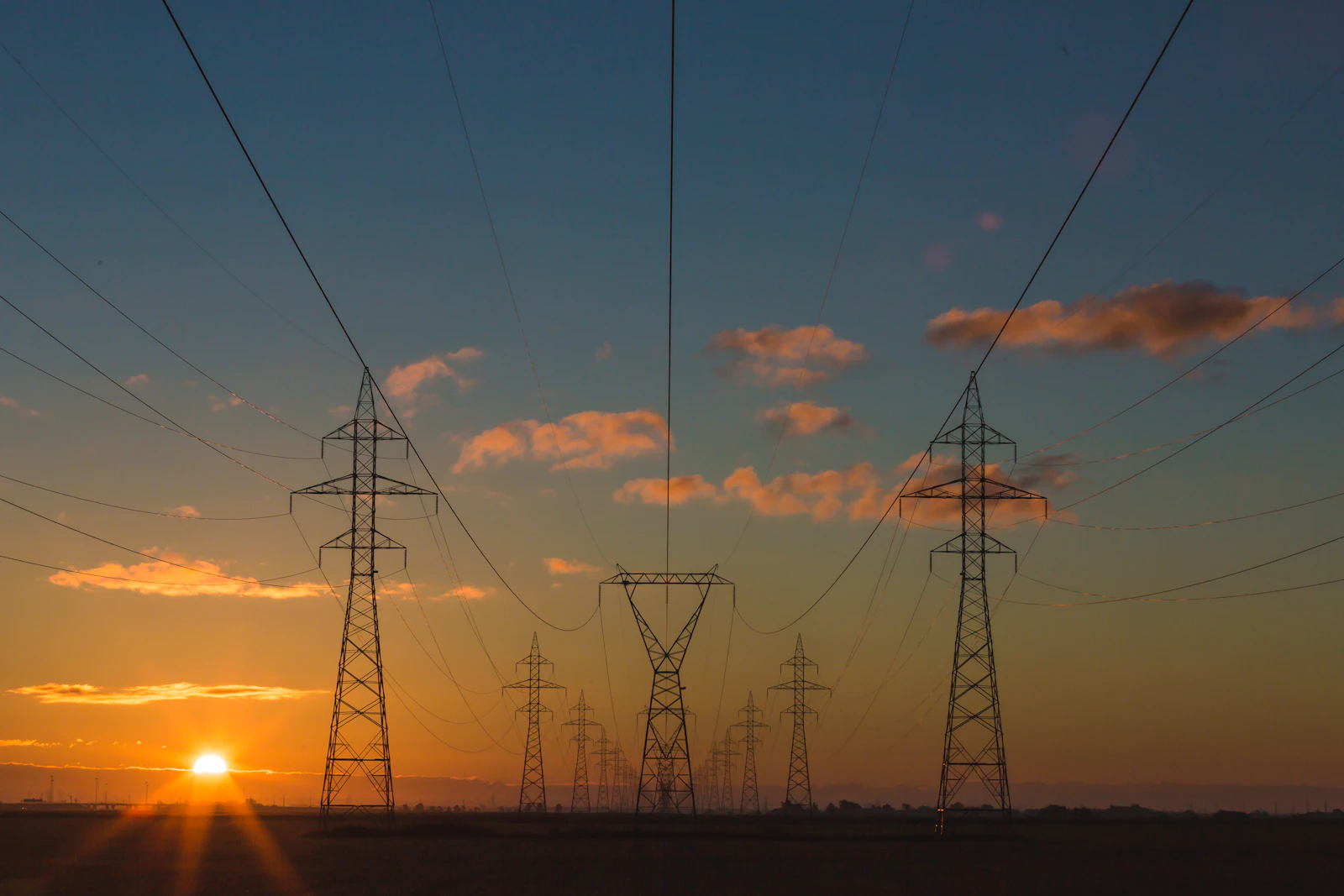
New, around-the-clock demand is reshaping the grid faster than clean supply can be built — and the gap is being filled with fossil power. Photo: Matthew Henry / Unsplash
And then there is your electricity bill. This is the part that turns an abstract debate into a kitchen-table one. When a data center plugs into a regional grid, it competes with households for a finite supply of guaranteed capacity — and prices everyone pays rise accordingly. In the PJM system, which serves 67 million people across 13 US states, the grid's own independent market monitor reached a remarkable conclusion about a single capacity auction.
$9.3 B
Higher electricity costs attributed to data centers in one PJM auction
The grid's independent monitor found data centers responsible for the majority of a record price increase — costs recovered from ordinary customers. Capacity prices later hit their ceiling, and the auction fell short of its reliability target for the first time ever.
Source: Monitoring Analytics (PJM market monitor)
Consumer advocates warn the cumulative toll could run to a hundred billion dollars or more by the early 2030s. In Washington DC, one utility's residential customers saw monthly bills jump by around twenty dollars, roughly half of it traced to those capacity prices. There is something quietly corrosive about a technology marketed as a public good whose first tangible effect, for many people, is a more expensive utility statement.
To their credit, the largest AI firms know fossil expansion is a dead end and are reaching for cleaner firm power — chiefly nuclear. Microsoft has contracted to restart a reactor at Three Mile Island; Amazon, Meta and Google have all signed nuclear or small-modular-reactor deals. These are genuinely good commitments. They are also slow: most of that clean power won't arrive until the late 2020s or 2030s. The demand is here now. The gap, for the moment, is being filled with carbon.
When "net zero" meets a GPU order
For a decade, the hyperscalers were the climate movement's favorite corporations — buying renewables at scale, publishing slick sustainability reports, racing to be "carbon neutral." AI has collided with those promises, and the reports themselves now tell the story.
+48%
Rise in Google's greenhouse-gas emissions, 2019–2023
Driven by data-center energy and supply-chain emissions. Google's report conceded that cutting emissions may get harder as it integrates AI — and it quietly stopped claiming operational carbon neutrality.
Source: Google Environmental Report, via NPR
Microsoft tells a similar tale: total emissions up by roughly a quarter since its 2020 baseline, the increase attributed to the AI and cloud build-out. The detail underneath matters: the company actually cut the emissions from running its operations, but the emissions embedded in building all that infrastructure — the concrete, the steel, the chips, categorized as "Scope 3" — swamped the savings. More than 97% of Microsoft's footprint sits in that supply-chain bucket. Its own chief sustainability officer captured the predicament with rare candor.
In 2020 we called our climate target a moonshot. The moon has gotten further away.
Melanie Nakagawa, Chief Sustainability Officer, Microsoft (paraphrased)
This is the most under-appreciated fact in the whole debate, and the one an engineer should sit with longest: a huge share of AI's climate cost is poured before a single model is trained. Concrete production alone is responsible for as much as 8% of human CO₂ emissions, and an AI campus is an ocean of it. When Hugging Face researchers tallied the full footprint of training one large open model, only about half came from the electricity the chips drew. The rest came from idle infrastructure overhead and from manufacturing the hardware itself. Per-query "efficiency" metrics — the comforting "it's just a few watt-hours" framing — quietly leave most of that concrete and silicon off the books.
Which brings us to the credibility problem with offsets. Buying renewable-energy certificates lets a company claim "100% renewable" on an annual spreadsheet while its servers actually run on whatever the grid is burning at 2am — often gas or coal. It is accounting, not physics. The more honest standard, which the better operators are now adopting, is to match every hour of consumption with clean power on the same grid. We'll return to that distinction in the solutions, because it is the single clearest line between greenwashing and genuine decarbonization.
Land, noise, waste and the stuff inside the box
Energy, water and carbon dominate the headlines, but a data center is a physical intrusion in other ways too, and the people who live nearest feel them first.
Noise is the complaint that turns neighbors into organisers. The cooling systems and backup generators produce a relentless low-frequency hum that ordinary noise ordinances, written around traffic and barking dogs, struggle even to measure. In Chandler, Arizona, residents near one campus described a drone that simply never stopped — and the city eventually amended its zoning rules and began questioning whether new data centers belonged there at all. As one official put it, the math that made these buildings welcome a decade ago no longer adds up for the community hosting them. By 2026, families near another AI power-plant site had filed a federal class action on behalf of more than ten thousand people.
E-waste and materials are the hidden tail of the hardware race. The world already generates well over 60 million tonnes of electronic waste a year, and the rapid refresh cycles of AI accelerators — yesterday's cutting-edge chip is next year's scrap — add to the pile, much of which ends up leaching toxins in places like the Agbogbloshie dump in Accra. Upstream, the chips and magnets depend on copper, silicon, gallium and rare-earth elements whose mining scars landscapes and poisons water tables; by 2030, AI infrastructure could account for a meaningful slice of global demand for several of these minerals. When China tightened exports of gallium and rare earths, prices outside the country more than doubled in months — a reminder that "the cloud" rests on some very earthbound and geopolitically fragile supply chains.
None of these is civilization-ending. Together they make the point that a data center is not a clean abstraction humming in cyberspace. It is concrete poured on land, water pulled from a river, metal dug from a mountain, and noise pushed into a bedroom window. The question is whether those costs are acknowledged and compensated — or simply absorbed by whoever lives closest.
What AI gives back — stated fairly
An honest accounting cannot be a prosecution. If we only tallied the costs, we would be telling half the truth — and the engineer's chair will not allow it. AI is also one of the more powerful tools we have for fighting the very crisis its data centers strain. These benefits are real, and several are already in production.
Steelman · AI as a climate tool
Google DeepMind's GraphCast produces ten-day weather forecasts in under a minute on a single machine, more accurately than the gold-standard physics model it was benchmarked against — a direct boon for integrating wind and solar and for warning people ahead of extreme weather. AI has improved solar-output forecasting by around 40% in UK trials, helps satellites pinpoint methane leaks, accelerates the discovery of better batteries and solar materials, and — in a tidy irony — a DeepMind system cut the energy used to cool Google's own data centers by roughly 40%.
The efficiency trend is genuinely remarkable, and it deserves to be stated as plainly as the alarms. The IEA notes that the energy needed for a given AI task has been dropping by at least an order of magnitude a year — an improvement rate it calls essentially unprecedented in energy history. Each new chip generation does dramatically more compute per watt. Google now reports getting many times more computing out of each unit of electricity than it did five years ago, and runs some of the most efficient facilities on Earth, with a fraction of the overhead of a typical corporate server room.
~49%
Share of all global corporate clean-energy buying by the four big cloud firms
Amazon, Microsoft, Google and Meta are, collectively, the largest force funding new wind, solar and — increasingly — nuclear and geothermal capacity onto the grid. The same firms straining the system are also its biggest clean-energy customers.
Source: BloombergNEF (2026)
There is an economic case too, and it is not nothing: the data-center build-out represents hundreds of billions of dollars of investment, tax base and construction work. And concentrating compute in a hyperscale facility is genuinely more efficient than the same work scattered across thousands of small on-premises servers. A reflexive "data centers are bad" misses all of this. And the cost of not building is real too: this compute underpins the very climate-modeling, materials-science and grid-forecasting tools described above, and a country that bans data centers outright does not abolish the demand — it exports the jobs, the tax base and the emissions to wherever the rules are weakest. The honest question is not whether to build, but how.
But — and the conservationist's chair insists on the "but" — three honest caveats keep the optimism grounded. First, Jevons' paradox: when something gets cheaper and more efficient, we tend to use vastly more of it, and the new appetites of AI (video generation, "reasoning" models that think in long chains, autonomous agents) can each consume hundreds of times more energy than a simple query, swamping the per-task savings. Second, the efficiency story is real but it is not consent: a town's drained aquifer is not comforted by a favourable global average. Third, the benefits and the costs land on different people — the climate models and the shareholder returns accrue broadly, while the noise, the water stress and the power bills concentrate on specific communities. Progress that is real in aggregate can still be unjust in distribution. Both things are true at once, and a mature position has to hold them together.
The fixes are real — and mostly already invented
If the problem were intractable, this would be a gloomier essay. It isn't. Almost every harm above has a known, demonstrated solution; what's missing is not technology but the will, the disclosure and the rules to make the solutions standard rather than optional. Here is what accountability actually looks like, in concrete terms.

None of the fixes below is speculative. Each is already running somewhere — the task is to make it the default everywhere. Photo: Karsten Würth / Unsplash
Cool without drinking the river
The water problem is, increasingly, an engineering choice rather than a necessity. Microsoft has rolled out a zero-water cooling design — a closed loop that circulates the same coolant for the life of the facility instead of evaporating fresh water — and says it will save more than 125 million liters per data center per year. Direct-to-chip and full immersion cooling (literally bathing servers in a non-conductive fluid) cut cooling energy substantially and are now essential anyway, because the densest AI racks run far too hot for old-fashioned air. Where water must be used, it can be reclaimed or non-potable rather than drinking-quality. The Chilean fix — trading some water for a little more electricity by using air — is available to anyone willing to choose it.
Match clean energy by the hour, not the spreadsheet
This is the dividing line between marketing and decarbonization, so it deserves its own table.
Two ways to claim "clean" — and why only one is honest
| Annual REC matching | 24/7 carbon-free energy |
|---|---|---|
What it measures | Total clean energy bought over a year, anywhere | Every hour of use matched with clean power on the same grid |
Reality at 2am | Servers may run on coal or gas; certificates paper over the gap | Consumption is actually backed by clean supply, hour by hour |
Drives new clean build? | Weakly — rewards cheapest certificates | Strongly — forces investment in storage, geothermal, nuclear |
Honest label | "We bought a year's worth of renewables" | "We ran on clean power" |
Google has committed to running on 24/7 carbon-free energy by 2030 and already matches roughly two-thirds of its hourly consumption, with several regions above 80%. Firm clean power is the hard part of that equation, which is why the most interesting deals are in advanced geothermal — Google's partnership with Fervo Energy is putting always-on, weather-independent clean power onto the grid — and in the nuclear and small-modular-reactor commitments now scaling up. The point is not that any one source wins; it's that "clean by the hour" forces the build-out of exactly the firm, around-the-clock clean capacity the whole grid needs.
Put the waste heat to work
A data center is, thermodynamically, a giant heater that we currently throw away. The Nordics treat that heat as a resource instead. In Finland, a Microsoft project will pipe its waste warmth into a district-heating network serving the equivalent of around 100,000 homes; a Meta facility in Denmark already exports its heat to thousands of households; Stockholm aims to warm a tenth of the city this way. Captured and reused, European data-center heat could in principle cover a meaningful share of the continent's space heating, delivered more cheaply than gas. The technology is plumbing. The obstacle is that almost nobody is required to do it.
Make the numbers public — then make rules
Everything above depends on one unglamorous foundation: disclosure. You cannot manage what no one will measure, and right now most operators reveal little — by one industry survey, fewer than half even track their water use. The European Union has started to fix this, requiring data centers above a certain size to report their energy, water and efficiency to a public database. Germany has gone further, mandating waste-heat reuse and capping how inefficiently new facilities may run. Ireland now requires big new data centers to bring their own clean generation. And in the US, Oregon created the first dedicated electricity rate class for data centers, so that the cost of their demand falls on them rather than on households. More than forty such bills moved through US statehouses in a single year. This is what a sane settlement looks like: measure honestly, reuse what you can, and make the industry pay its own way.
A world for people, not just machines
Step back from the terawatts and the liters and the question underneath comes into focus. We are, very fast and with very little public debate, rebuilding the physical substrate of the planet — its power plants, its water rights, its land and air — around the needs of machine intelligence. That may turn out to be one of the better bets humanity has made. But a bet made only on the machines' terms, with rivers and neighborhoods and the climate treated as costs to be absorbed quietly, is not progress. It is enclosure with better branding.
The encouraging truth running through all of this is that we are not choosing between AI and a liveable world. The efficiency gains are real and rapid. The clean-energy demand from these same companies is the largest in the world. The cooling that doesn't drink rivers, the heat that warms homes, the power matched clean by the hour, the rules that make firms pay their way — none of it is science fiction. It is sitting in pilot projects and regulations and engineering specs right now, waiting to be made standard. The gap is not capability. It is accountability.
So the ask is specific, and it falls on three groups:
Regulators should make disclosure mandatory, make data centers pay for the grid and water they demand, and close the permitting loopholes that let unregulated power plants rise in the neighborhoods least able to fight them.
Companies should move from annual certificates to clean energy matched by the hour, publish their full footprint including the concrete and the chips, default to water-free cooling and heat reuse, and sign genuine community-benefit agreements before breaking ground — not after the lawsuits.
The rest of us should refuse the false choice between technophobia and blind faith, ask where our compute comes from, support the local organisers and the transparency laws, and reward the firms that choose the honest path over the cheap one.
The fuss, in the end, is not really about data centers. It is about whether the most powerful technology of our age will be built with the living world or against it — whether the future we are pouring concrete for has room in it for clean rivers, breathable air and people who can pay their electricity bills, alongside the machines. That future is still ours to specify. We should write it down before someone else pours it.